



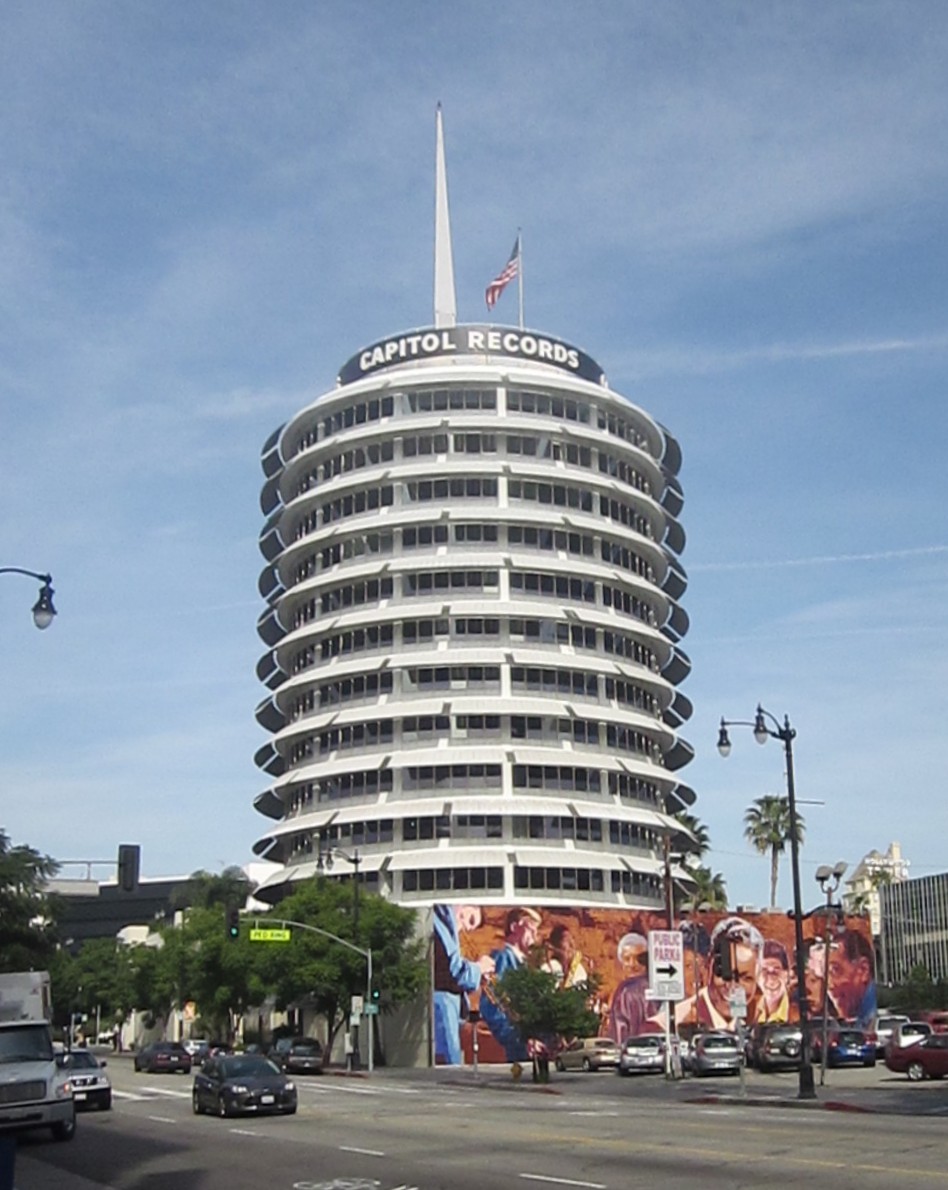
🏛️ Historical significance
- Completed in 1956, the Capitol Records Building was designed by architect Louis Naidorf of Welton Becket Associates. It is widely recognized as the world’s first circular office building, with stacked floor plates resembling a tower of vinyl records.
- Located at 1750 Vine Street, just north of Hollywood & Vine, it became the headquarters for Capitol Records, the first major West Coast record label.
- Nicknamed “The House That Nat Built” because Nat King Cole’s enormous sales helped fund Capitol’s growth.
- The building’s Morse‑code beacon atop the spire has blinked “Hollywood” continuously since 1956.
- Capitol Studios inside the tower became legendary for their Les Paul–designed echo chambers, used by Frank Sinatra, the Beach Boys, and countless others.
- It is a Los Angeles Historic‑Cultural Monument (HCM #857) and was added to the National Register of Historic Places in 2024.
🎬 Role in Hollywood culture
- The building is one of the most recognizable landmarks in Southern California and appears frequently in films, often as a symbol of Hollywood or as a target in disaster scenes (e.g., Earthquake, Independence Day, Hancock).
- From 2013–2015, the Academy Awards orchestra performed inside Capitol Studios, connected to the Dolby Theatre via fiber‑optic links—an unusual and technically complex collaboration.
Capitol Studios has one of the richest recording histories in the world. Below is a timeline of major albums recorded there (grounded in sourced data) and a clear comparison of Capitol Studios vs. other landmark Hollywood studios, so you can see how each facility shaped the sound of American music.
🕰️ Timeline of Major Albums Recorded at Capitol Studios
(All entries below are directly supported by sourced search results.)
1950s
- 1956 — Frank Sinatra, Tone Poems of Color First session ever recorded at Capitol Studios.
- 1956–1960 — Frank Sinatra, multiple classics Songs for Swingin’ Lovers! (1956), Come Fly With Me (1958), Only the Lonely (1958), Nice ’N’ Easy (1960).
1960s
- 1962 — The Beach Boys, Surfin’ Safari Recorded most of their debut LP here.
- 1963 — The Beach Boys, Surfin’ USA Their second album, peaked at #2 in the U.S.
- 1963 — Nat King Cole, Those Lazy-Hazy-Crazy Days of Summer A major Capitol hit.
- 1963 — Ella and Louis (Ella Fitzgerald & Louis Armstrong) Recorded in one day at Capitol.
- 1967–1968 — Glen Campbell, By The Time I Get to Phoenix (1967), Wichita Lineman (1968) Career-defining recordings.
1970s
- 1970 — Bobbie Gentry, Fancy (partially recorded here)
- 1968 & 1973 — The Band, Music From Big Pink (finished here), Moondog Matinee
- 1973 — Gram Parsons, Grievous Angel (final LP)
- 1973 — Steve Miller Band, The Joker Another major Capitol-era success.
- 1977 — Carole King, singles including “God Only Knows” for Simple Things
1980s
- 1985–1986 — Bob Seger & The Silver Bullet Band, Like a Rock Recorded during a long residency.
1990s–2000s
- 1990 — Happy Mondays, Pills ’N’ Thrills and Bellyaches (partially recorded here)
- 1999 — Elliott Smith, Figure 8 (released 2000)
- 2001 — Michael Jackson, Invincible (portions recorded here)
- 2004 — Green Day, American Idiot (partially recorded in Studio B)
2010s–2020s
- 2013 — Arcade Fire, rooftop performance at Capitol (pre-renovation)
- 2013 — Daft Punk, Random Access Memories (sessions at Capitol)
- Recent years — Tony Bennett, Muse, Sting, Coldplay, Britney Spears, Ozzy Osbourne All recorded or mixed at Capitol.