

THE HOUR OF THE STAR – Broadwater Blackbox Theatre
Reviewed by Amalisha HuEck
The soothing sounds of the rain on the roof of the building: a perfect time for a writer to get inspired and write a fantastic story.
In the corner of a small room, the typewriter is being used, and we watch for a while as the thoughts of the writer are mimed — his frustration at not getting what is needed and finally, when the right idea sets in, as inspiration takes over and the story flows.
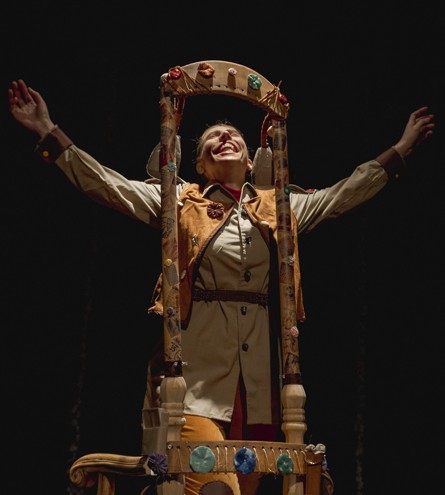
All is fabulously illustrated by Brazilian actress Bruna Fachetti, who takes us wholeheartedly on a journey into a new stage adaptation of a famous, super talented Clarice Lispector’s acclaimed novella The Hour of the Star, a landmark of Brazilian literature.
The story takes place in Rio de Janeiro, where novelist, short story writer and journalist Lispector moved in her teens. Injured in an accident in 1966, she spent the last decade of her life in frequent pain, steadily writing and publishing novels and stories until her premature death in 1977. The Hour of the Star was published shortly before she died. Through this production we explore the final masterpiece of this beloved Brazilian author.
It is the story of the fictional character, Macabéa, whose philosophy is to take care of herself and not put the responsibility of her life in someone else’s hands. It was important to have Macabea as a central character because she sees the world through childlike eyes, and her innocence is portrayed in comparison with everyone else who has strong opinions and their own jaded views on life.
She is a breath of fresh air, and we feel drawn to her. Macabéa is one of seven characters in the story: we also enjoy the portrayal of Rodrigo, the storyteller; Olympico, her love interest; Gloria, the girl; Madame Carlotta, the card reader; the Doctor; and “Death.”
Having been coached by renowned master teacher Marjo-Riikka Mäkelä, founder of Chekhov Studio International, Fachetti’s seven-character development and performance is clearly recognized as Chekhov technique. By digging deeply into several foundational concepts, psychological gestures, imaginary body, atmosphere, and radiating energy Fachetti bypasses conventional emotional triggers, allowing the subconscious, more spontaneous and liberated performance to occur. She truly embodies all the characters and flows through them with ease.
The culture of the northeast part of Brazil is symbolized by Macabea’s jacket with its Coca-Cola button, many different fuxico’s (flowers), and other sewn-on symbols. They represent the theme of being independent and having a voice. The chair on the stage is also totally custom-made with a tall back, not very straight, but slightly tilted towards inside, and covered in fuxico flowers as well.
The striking image of the strawberry season is used, which evokes the idea of something sweet and simple that can still be appreciated in the face of loss, much like Macabéa’s own life, which was marked by poverty but also by a kind of unspoiled, free-spirited joy. Strawberries in The Hour of the Star are a quiet, poignant symbol of impermanence, the continuity of life cycles, and the possibility of finding sweetness in the ordinary, even in the shadow of death.
The visualization of the rain falling is successfully illustrated by bubbles blowing through the colorful light. The effect is wonderfully intriguing and truly magical.
Clarice Lispector is the subject of numerous books and references to her. Several of her works, including ‘Hour of the Star,’ have been turned into films, and she was the subject of a recent biography, Why This World’, by Benjamin Moser. Australian actress, Cate Blanchett has been known to quote this writer when receiving an award.
This production is made possible through the generous support of Brazilian-owned organizations and businesses, including the Consulate General of Brazil in Los Angeles, Ubatuba Açaí, Webook, MattenLaw and the Los Angeles Brazilian Film Festival (LABRFF). Industry partners WETheLatin, Kiss my Tra$sh, Michele Curcho and Brazil for All continue to champion the project’s mission of building cultural bridges through the arts.
Conceived and artfully directed by Alex Tietre the story of Macabéa, a poor typist living on the margins who dreams of a better life in Rio de Janeiro, is limited to five performances only.
Performances of The Hour of the Star take place at 7 p.m. on Saturday, July 25; Sunday July 26; Thursday, July 30; Friday, July 31; and Saturday, Aug. 1. All tickets are $20. The Broadwater Black Box Theatre is located at 6322 Santa Monica Blvd. LA, CA 90038. To purchase tickets, go to www.thehourofthestar.eventbrite.com