

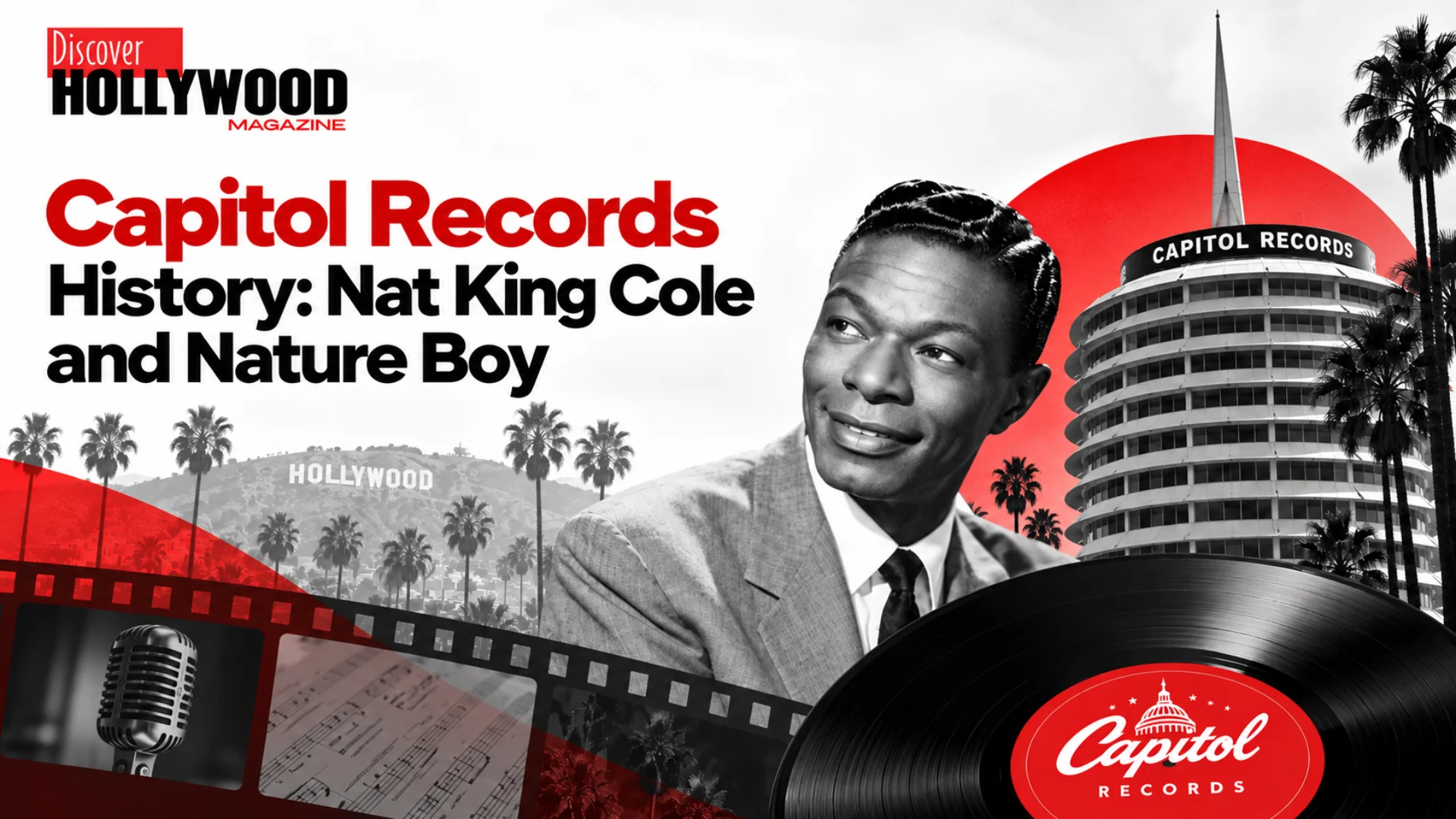
At Hollywood and Vine, the Capitol Records Tower rises above the neighbourhood like a stack of records waiting to be played. Its story began before the building opened in 1956, with Capitol Records’ founding and Nat King Cole’s success. One of Cole’s defining recordings, “Nature Boy,” came from an unlikely source: the songwriter Eden Ahbez.
Johnny Mercer Brings a Record Company West
In 1942, acclaimed songwriter and singer Johnny Mercer joined songwriter and film producer Buddy DeSylva and music retailer Glenn Wallichs to establish Capitol Records.
It was the first major record label based on the West Coast. Until then, the American recording business was largely centered in New York. Creating Capitol in Hollywood placed the record industry closer to the musicians, singers, filmmakers and radio performers already working here.
Capitol’s early offices were located near Sunset and Vine, and the fledgling company’s roster grew rapidly. One of its most important artists was a gifted pianist and vocalist named Nat King Cole. Learn more about the history, growth, and corporate journey of Universal Studios in this in-depth Hollywood feature.
Nat King Cole Helps Build Capitol
Cole had already made a name for himself with the King Cole Trio when his smooth, unmistakable voice began moving to the foreground. His Capitol recordings attracted an enormous audience and helped transform him into one of America’s most important popular singers.
His success was so consequential that the future Capitol Records Building would become known as “the House That Nat Built.”
But one of the defining songs of Cole’s career came from far outside the established music business.
The composer was Eden Ahbez, a long-haired, sandaled wanderer whose life bore little resemblance to conventional Hollywood. Ahbez embraced vegetarianism, nature and a simple way of living years before the counterculture movements of the 1960s. According to Hollywood legend, he sometimes camped beneath the Hollywoodland Sign on Mt. Lee.
His unlikely path to Capitol Records began with a song called “Nature Boy.”
Eden Ahbez Comes Down From the Hills
In 1947, Ahbez tried repeatedly to get “Nature Boy” into Nat King Cole’s hands. Accounts of the precise delivery differ, adding to the story’s mythology, but the song eventually reached Cole.
Released in 1948, Cole’s recording of “Nature Boy” became one of his signature songs.
Its haunting melody and message of love seemed to come from another world. Yet it emerged from Hollywood, from its hills, cafés, music rooms, and community of outsiders and dreamers.
The song also arrived during a time when racial segregation remained part of Los Angeles life. Cole, a Black artist, and Ahbez, an unconventional composer living on society’s margins, created a recording that reached listeners across those divisions.
“Nature Boy” became one of Cole’s signature songs and strengthened Capitol’s position as a major force in American music. It also established Ahbez as one of Hollywood’s most unusual songwriters. Read more about Eden Ahbez in Brian Chidester’s article “One Magic Day He Came Out Way”
The Tower Rises at Hollywood and Vine
By the 1950s, Capitol Records had outgrown its earlier Hollywood locations. The company’s famous tower at 1750 Vine Street was completed in 1956.
Designed by Louis Naidorf of Welton Becket Associates, the 13-story landmark is widely recognized as the world’s first circular office building. Its curved floors and rooftop spire give it the appearance of records stacked on a turntable, although its architect maintained that resemblance was coincidental.
Inside, Capitol Studios became nearly as legendary as the building itself. Frank Sinatra, Peggy Lee, the Beach Boys and countless other artists created music there. Specially constructed underground echo chambers gave recordings a richness that could not easily be duplicated elsewhere.
Through it all, Nat King Cole remained central to the Capitol story- the artist whose record sales helped make the company’s extraordinary growth possible.
A Landmark Enters Another Chapter
In 2023, Universal Music Group acquired a 50 percent interest in the entity that owns the Capitol Records Building and secured a long-term lease. The arrangement extended the company’s connection to the Hollywood landmark. Experience the magic of live theatre with Disney’s Beauty and the Beast at the Hollywood Pantages Theatre.
Hollywood, the Place Where It Happened
Acoording to Discover Hollywood, before the tower opened, Capitol had already given Nat King Cole and “Nature Boy” a home. That earlier history is easy to miss when we’re looking up at the building. It’s worth remembering the next time we pass Hollywood and Vine.