

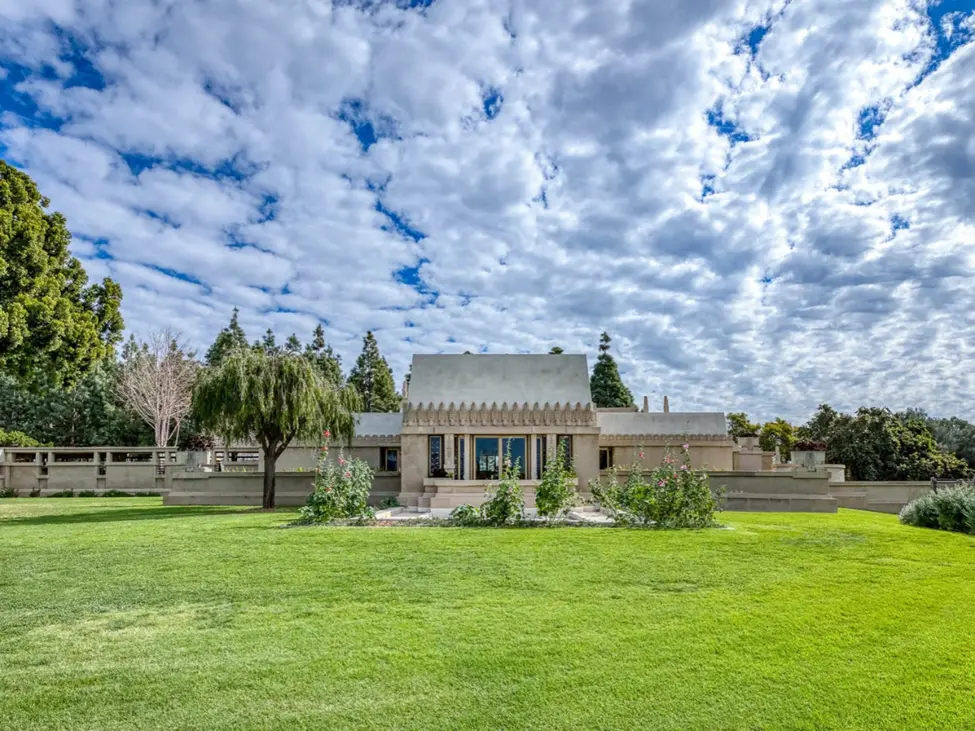
You’re walking up a quiet hill just off Hollywood Boulevard. The tour buses are gone. The Walk of Fame crowds feel a mile away. Then a strange, beautiful concrete house comes into view, covered in stone flowers that look almost prehistoric.
That’s Hollyhock House. Most visitors to Hollywood never find it.
This Hollyhock House history guide will show you the details of that world heritage. On July 7, 2019, UNESCO named the house a World Heritage Site, according to the City of Los Angeles Department of Cultural Affairs. It became the only site with that honour in Los Angeles.
Most guides list a few facts and move on. This one walks you through the story, the design, and exactly how to plan your visit.
Hollyhock House History Guide: The Story Behind Hollywood’s Hidden Landmark
Every great building starts with a person who refused to compromise. Hollyhock House started with Aline Barnsdall.
She had money, opinions, and a plan nobody else in Hollywood was thinking about in 1919.
Who Was Aline Barnsdall?
Barnsdall was an oil heiress from Pennsylvania. She wasn’t interested in a quiet life. She loved experimental theater. She wanted to build a full arts complex in Los Angeles, not just a house.
She bought a 36-acre property called Olive Hill. It stretched from Hollywood toward Sunset Boulevard.
Her plan included a theater, actors’ housing, shops, and a private residence for herself. Only part of that vision ever got built. But the part that survived became one of the most important homes in American architecture.
Why Frank Lloyd Wright Designed Hollyhock House?
Barnsdall wanted an architect who matched her ambition. She chose Frank Lloyd Wright.
This was his first major project in Los Angeles. The Frank Lloyd Wright Hollyhock House commission gave him a blank canvas, which he rarely got elsewhere.
He didn’t want to copy the Prairie-style homes he’d built in the Midwest. Southern California called for something different.
Wright borrowed shapes from ancient Mesoamerican temples. He mixed them with Japanese-influenced layouts and California’s indoor-outdoor lifestyle. The result had no obvious ancestor. It still doesn’t.
How a Private Residence Became a Cultural Landmark?
Barnsdall never fully settled into the house the way most owners would.
She donated it to the City of Los Angeles in 1927, along with much of the surrounding land. She wanted the public to have access to art and architecture, not just wealthy patrons.
The California Art Club used the building as its headquarters for fifteen years, starting in 1927.
Decades of earthquakes and water damage followed. A major restoration ran from 1974 to 1976, turning the building into a public museum. A second, deeper restoration wrapped up in 2015. That work uncovered original details that had been hidden or altered for decades.
What Makes Hollyhock House Frank Lloyd Wright’s Most Fascinating Designs?
Step inside and you’ll notice something right away. Nothing here looks like a typical 1920s home.
The Hollyhock Flower Hidden Throughout the Design
Barnsdall loved a simple garden flower called the hollyhock. Wright turned it into an architectural language.
You’ll find stylized hollyhock shapes carved into cast-concrete columns. They appear again on furniture, art glass, and decorative friezes near the roofline.
It’s a small detail with a big effect. The whole house feels connected to something living, not just built.
How Hollyhock House Changed California Architecture?
Wright called his approach here “California Romanza.” He meant it as architectural freedom, built around the local climate and light.
Rooms open onto courtyards instead of hallways. Walls of glass blur the line between inside and outside.
Architect Rudolph Schindler supervised construction after Wright left for Japan, and Wright’s son Lloyd Wright was also involved. Richard Neutra was not part of the original build. He came to Los Angeles later, at Schindler’s urging. Schindler and Neutra both went on to reshape modern architecture across Southern California.
You can trace a direct line from this hillside house to the sleek mid-century homes scattered across the Hollywood Hills today.
Architectural Details You Should Notice During Your Visit
Slow down in these spots. They’re easy to miss if you rush through.
- A living room hearth topped with a skylight and a floating stone relief
- Cast-concrete hollyhock motifs on columns and friezes
- Art glass windows designed to catch shifting daylight
- An interior courtyard that anchors the entire floor plan
- Roof terraces that Wright designed as outdoor living space (ask staff which areas are open to visitors, or see them on the virtual tour)
- Rooms that flow directly into outdoor garden space
- A design that avoids straight hallways in favor of connected spaces
Why Is Hollyhock House a UNESCO World Heritage Site?
Getting global recognition took longer than most people assume.
The World Heritage Committee first reviewed Wright’s buildings in 2016, requested more research, and the Frank Lloyd Wright Building Conservancy resubmitted in 2018 before the 2019 inscription.
On July 7, 2019, the World Heritage Committee inscribed Hollyhock House as part of a serial listing called “The 20th-Century Architecture of Frank Lloyd Wright.” Seven other Wright buildings joined it, including Fallingwater in Pennsylvania and the Guggenheim Museum in New York.
This was the first modern architecture designation UNESCO had ever given a U.S. site, according to the Los Angeles Department of Cultural Affairs.
That UNESCO World Heritage site Los Angeles distinction matters beyond the plaque out front. It confirms Wright’s influence reached far past America’s borders, shaping how architects everywhere think about space, light, and material.
For Los Angeles, it means the city holds its first entry on a U.S. list that now includes 27 sites.
Planning Your Visit to Hollyhock House, Los Angeles
The house sits at 4800 Hollywood Boulevard, inside Barnsdall Art Park. It’s easy to reach by car, rideshare, or Metro bus.
| Detail | Information |
| Address | 4800 Hollywood Blvd, Los Angeles, CA 90027 |
| Self-guided visits | Thursday through Saturday, 11:00 AM–4:00 PM (last entry 3:30 PM) |
| Guided tours | Exterior tour on Fridays and Saturdays; 1-hour tour on Sundays |
| Adult Entry Tickets | $12 |
| Senior (62+) / Entry Tickets | $6 |
| Students (18+ with ID) | $6 |
| Youth under 18 | Free with a paying adult |
Hollyhock House Los Angeles sits at the top of a hill in Barnsdall Art Park. Parking is free but limited, with lots at the top and bottom of the hill. If you park at the bottom, you’ll climb stairs on the east end. Accessible parking is in the motor court between the Visitor Center and the house.
Ticket details and same-day availability change often, so confirm current pricing and schedules on the official Hollyhock House website before you head out. The house is closed on Thanksgiving weekend and from Dec. 24 into early January.
Accessibility: What to Know Before You Go
Hollyhock House has two stories, and many rooms on the first floor require steps to enter. The interior has 23 steps in total. A ramp at the entrance helps visitors get into the house, but it doesn’t make every room step-free.
Visitors can use their own wheelchairs, walkers, and canes. Staff may cover or wipe the wheels before you enter to protect the floors. The official site doesn’t list loaner wheelchairs, so ask ahead if you need one.
If you have mobility concerns, plan before you go:
- Email hollyhockhouse@lacity.org or call (323) 913-4030.
- Explore the online Virtual Accessibility Experience, which offers 360-degree views of all spaces open to the public, with written and audio information.
- Large-print and braille booklets are available inside the house.
- Sign language interpreters need five or more business days’ notice.
Mornings on weekdays tend to be quieter than weekend afternoons. If you want fewer people in your photos, aim for an early Thursday visit.
Hollyhock House Tour Tickets: What Visitors Should Know?
You have three ways to see the house, and Hollyhock House tour tickets work a little differently for each.
- Self-guided visit (Thursday–Saturday): Explore at your own pace. Docents are stationed throughout the house to answer questions, and free printed and digital guidebooks walk you through each room.
- Docent exterior tour plus admission (Fridays and Saturdays): A 20-minute tour of the exterior and gardens, followed by a self-guided visit inside. It runs at 11:30 AM, 12:00 PM, 12:30 PM, and 1:00 PM, and costs $24 for adults and $12 for seniors and students.
- 1-hour guided tour (Sundays only): A longer look at the interior and exterior, limited to 12 people.
Advance tickets are strongly recommended because of limited daily capacity. Standby tickets are sometimes available onsite Thursday through Saturday between 11:30 AM and 3:30 PM, but they can’t be guaranteed.
Explore Barnsdall Art Park After Visiting Hollyhock House, LA
Don’t leave the moment you exit the house. Barnsdall Art Park Hollywood surrounds the building, and it’s worth an hour on its own.
The park includes the Barnsdall Gallery Theatre, the Los Angeles Municipal Art Gallery, and a working arts center that runs classes for the community.
Olive trees planted decades ago still shade the hillside paths. Wide lawns give you room to sit and take in skyline views stretching toward downtown. Rotating art exhibitions keep the gallery spaces fresh, so no two visits look the same.
This is where the trip stops feeling like a single stop and starts feeling like a full afternoon in Hollywood’s cultural corner.
Things to Visit Near Hollyhock House in Hollywood, LA
| Attraction | Why Visit | Approximate Distance |
| Griffith Observatory | City views, telescopes, and space exhibits | 10-minute drive |
| Hollywood Walk of Fame | Iconic stars honoring entertainment legends | 5-minute drive |
| Hollywood Boulevard | Historic theaters, shops, and street life | 5-minute drive |
| Greek Theatre | Historic outdoor concert venue in Griffith Park | 10-minute drive |
How to Choose the Best Hollyhock House Experience
Different visitors get different things out of this stop. Here’s how to make the most of yours.
- Architecture lovers: Move slowly through each room and study the concrete detailing up close.
- Families: Visit on a quieter weekday morning and pair it with park time for kids to run around.
- History visitors: Read the guidebook sections on Barnsdall before touring the house itself.
- Photographers: Aim for late morning light in the courtyard and gardens. Photos are welcome without flash.
- First-time Hollywood visitors: Combine this stop with the Walk of Fame for a full day that mixes history with entertainment culture.
The Hidden Details: Hollyhock House Guides Don’t Tell You
A few things rarely make it into standard write-ups.
- The house was never fully finished the way Barnsdall originally imagined it. Budget problems cut her larger arts complex short.
- Wright was largely absent during much of construction, working from Japan on the Imperial Hotel project at the time.
- His son, Lloyd Wright, and architect Rudolph Schindler supervised day-to-day work in his absence.
- The living room’s floating stone hearth was designed to seem like it has no visible support.
- Water damage plagued the house for decades before the 2015 restoration finally addressed the root causes.
Understanding Hollyhock House, Los Angeles
Here’s a simple way to hold everything you’ve learned in one place.
- Story: Aline Barnsdall’s arts vision and her partnership with Frank Lloyd Wright shaped every decision behind the house.
- Design: Wright’s hollyhock motifs, courtyards, and California Romanza style turned a private home into an architectural statement.
- Experience: Barnsdall Art Park lets you walk through that story today, from the entry ramp to the courtyard and gardens.
Keep those three layers in mind as you walk through, and the house tells you a lot more than its walls alone.
FAQ’s
1. Why is Hollyhock House famous?
It’s Frank Lloyd Wright’s first Los Angeles project and a UNESCO World Heritage Site. Aline Barnsdall commissioned it in 1919 as the centerpiece of an arts complex.
2. Who designed Hollyhock House?
Frank Lloyd Wright designed the house. Rudolph Schindler and Wright’s son Lloyd Wright helped oversee construction, which ran from 1919 to 1921. Richard Neutra came to Los Angeles later and made his own contributions to the site.
3. Is Hollyhock House worth visiting in LA?
Yes, especially if you care about architecture or Hollywood’s cultural history beyond the Walk of Fame. Self-guided tickets start at $12, and the visit pairs well with Barnsdall Art Park.
4. How do you get Hollyhock House tour tickets?
Book online through the official Hollyhock House website before your visit. Capacity is limited, and standby tickets aren’t guaranteed onsite.
5. Why is Hollyhock House a UNESCO World Heritage Site?
UNESCO inscribed it on July 7, 2019, as part of a group listing of eight Frank Lloyd Wright buildings. It marked the first modern architecture designation UNESCO had given any U.S. site.
Why Hollyhock House Deserves a Spot on Your Hollywood Itinerary in LA?
This Hollyhock House history guide covers more ground than a quick fact sheet ever could, because the house rewards that kind of attention.
- Aline Barnsdall’s arts vision gave Los Angeles a building unlike anything else in the city.
- Frank Lloyd Wright used the project to develop a design language built for California light and living.
- UNESCO’s 2019 recognition confirmed what Hollywood locals already knew about this hillside landmark.
Set aside a morning, plan your route through Barnsdall Art Park, and see the house that started California modernism for yourself.