

Reviewed by Nathan Larkins
I Finally Understand the Spell
I walked into The Phantom of the Opera with baggage.
I had seen the show before. I had seen the movie. I knew the music. I understood why The Phantom mattered in the musical theatre canon. What I did not have, at least not until this production, was a relationship with it.
I get it now.
Now at the Hollywood Pantages Theatre through August 9, Cameron Mackintosh’s production of Andrew Lloyd Webber’s The Phantom of the Opera understands exactly why this show has endured. It is massive, yes. It is lush, yes. But what won me over was not simply the size of it. It was the purpose behind the spectacle.
From the opening auction, the production teaches us how to watch it. The opera house begins as a ruin, its remnants covered, priced, and sold like the ghosts attached to them are somehow manageable. An older Raoul sits among the wreckage, purchasing the monkey music box not as a novelty, but as a piece of a life he has never fully escaped.
Then the famed chandelier appeared.
Covered in the same tired burlap as the rest of the opera house’s remains, it first feels like another dead object being dragged out of storage. Then the covering is pulled inward, almost swallowed by the chandelier itself, and it erupts back to life. Sparks, pulses, light, sound — the whole theater seems to receive a jolt.
It is not just a reveal. It is a defibrillator.
The organ hits. The overture tears through the room. The past comes roaring back with a melody that will almost certainly live in your head rent-free for the rest of the week. Suddenly, we are not watching a story begin. We are watching memory take the stage, dust itself off, and become dangerous again.
Maria Björnson’s production design remains stunning, not because it creates pretty pictures, but because it creates emotional terrain. The opera house feels grand, decaying, seductive, and unstable all at once. It is a place of performance, but also a place of secrets. A building with a pulse.
The undercity sequences were especially effective. The forced perspective made the space feel endless, as though we had followed Christine so far beneath the opera house that we might never escape, even if we tried. The world below seemed built from memories and fragments, with no clean beginning or end. The stage became something shattered and half-remembered, which made the descent feel less like a simple location change and more like entering the emotional architecture of the story itself.
That immersion was not only visual. Mick Potter’s sound design deserves its own bow. The Phantom did not simply sound as though he was onstage. His voice surrounded the audience, moved through the space, and made the theater itself feel possessed. He was everywhere and nowhere at once. That sonic positioning was a huge part of why the character worked. We understood how a man could become a myth if the room itself seemed to speak with his voice.
The orchestra, with musical direction by Isaac Hayward and musical supervision by Kristen Blodgette, gave Lloyd Webber’s score the sweep it demands without letting it become mush. The music had weight, but it also had clarity. The big moments landed, but so did the emotional ones.
And then there were the voices.
This is one of those productions where you remember, very quickly, why live musical theater matters. Bodies, breath, orchestra, architecture, timing, silence — all of it colliding in the same room. There is no substitute for that.
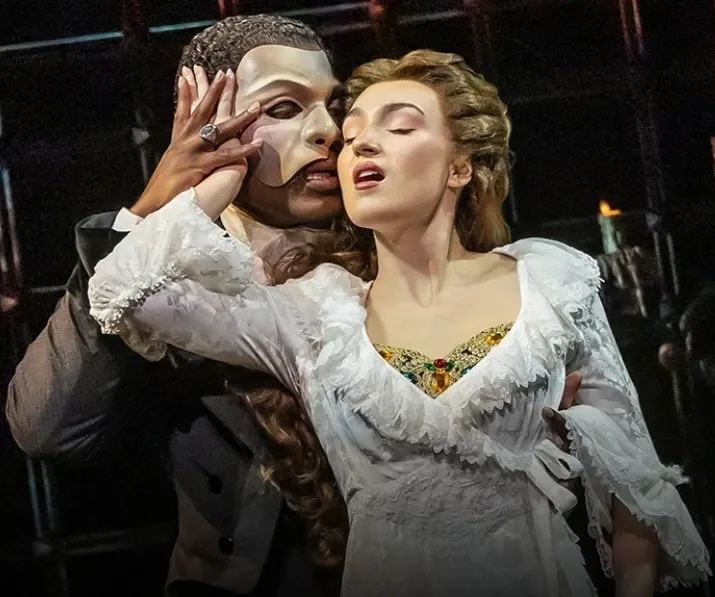
Isaiah Bailey’s Phantom was a revelation. Not because the performance tried to make him safe. It did not. He is dangerous. He is manipulative. He is obsessive. He is, to put it lightly, not handling rejection with an impressive amount of emotional regulation.
But Bailey made him legible.
That is different from excusable, and it matters. This Phantom was not just a spooky man in a basement. He was a damaged artist who had built an entire world out of isolation, genius, pain, and sound. The production allowed us to see the monster without losing sight of the person inside it.
The biggest surprise of the night for me was “The Music of the Night.”
I had always understood the song as a famous musical theater moment. The seduction number. The big melody. The one everybody knows. But this staging brought a completely different way into it.
He was teaching Christine.
Not just tempting her. Not just flaunting. Teaching her.
It became a lesson in how to speak through music, how to feel through it, how to let sound carry the things language cannot. It felt like watching someone for whom music is second nature trying to explain something as instinctive as breathing or pumping blood. Christine is the only person he has ever met who can come close to understanding his language, and that possibility makes him both thrilling and terrifying.
Watching Bailey crawl, plead, and practically beg her to understand what it means to truly feel through music turned the number from a familiar showpiece into something raw and specific. He was not asking Christine to admire him. He was pleading for her to understand the only language he has ever had.
That choice changed the Christine, the Phantom, and Raoul love triangle.
Jordan Lee Gilbert’s Christine is not simply a prize between two men, and the production is strongest when it refuses to treat her that way. She is grieving, curious, overwhelmed, gifted, frightened, powerful, and constantly being told who she is by people who want something from her. Her voice becomes the center of everyone else’s desire, but her journey is about discovering that it belongs to her.
Then there is Raoul.
Daniel Lopez’s Raoul was more interesting than expected because this production allowed him to be complicated. The direction and performance gave the audience permission to notice his entitlement. Not in a mustache-twirling way. He is not suddenly the villain. He is brave. He is sincere. He cares for Christine. But there is also a confidence to him, a boisterous certainty, as though knowing her from childhood gives him the right to know what is best for her now.
That tension made the love triangle feel alive. Traditionally, Raoul can read as the obvious safe choice: daylight, normalcy, the socially acceptable escape route from the masked man beneath the opera house. But here, I found myself questioning the shape of that safety. Both men, in wildly different ways, believe they understand Christine. Both men try to pull her toward a future they have imagined for her. And Christine, increasingly, is the one losing her mind inside everyone else’s certainty.
That is what gives the ending its force.
The production sharpens the difference between love as possession and love as release. Somewhere in the wreckage, the Phantom realizes that the thing he wants most cannot be kept. Christine’s voice is not his. Her life is not his. Her freedom is not his.
Music can invite, reveal, and transform, but it cannot possess.
That emotional clarity was not limited to the principal trio. The casting felt pointed. Surgical, even. No one seemed to be fighting uphill against a role that did not fit them. Every performer knew the assignment, and each artist attacked it with clarity, from the principals down through the ensemble.
Midori Marsh’s Carlotta deserves a serious mention. Every time she opened her mouth, the room shifted. Marsh brought the kind of vocal command and theatrical presence that makes the character more than a diva archetype. She was funny, formidable, technically dazzling, and impossible to ignore.
The ensemble work was also a joy. Each dancer and ensemble member seemed to carry a distinct inner life. They were not simply filling space or executing choreography. They were building the world of the opera house from the inside out. Watching individual personalities emerge through the ensemble work was one of the reasons I would want to see the production again. There was too much happening, too many small choices, too much life onstage to catch in one sitting.
The same goes for the technical execution. In a show this demanding, smoothness is not an accident. It is the result of a small army of people making very complicated things look inevitable. From my seat, there was not a visibly missed cue all night. Scenic shifts, sound placement, musical timing, reveals, transitions — the whole machine moved. Production stage manager Jovon E. Shuck, stage manager Mariah Young, assistant stage managers Kyle Dannahey and Claire Farrokh, and the entire stage management team deserve recognition because when work this complicated runs perfectly, the audience is not supposed to notice how hard it is.
I noticed.
Or maybe more accurately, I noticed that I was never pulled out of the moment.
So, at the end of the day, the clearest thing I can say is this: go see this production.
If you already love The Phantom of the Opera, run.
If you are a skeptic, a doubter, or someone who has somehow made it this far without seeing Phantom, maybe especially go. This production is a testament to what a show can be when spectacle is matched by thoughtful direction, emotionally specific performances, technical precision, and a deep understanding of music as the language at the heart of the story.
Phantom of The Opera runs through Augut 9, 2026 at the Hollywood Pantages Theatre, 6233 Hollywood Blvd, Los Angeles, CA 90028. For tickets call (323) 468-1770.
About the reviewer: Nathan Larkins is a Los Angeles-based performer, writer, and consultant with a background in musical theatre and vocal performance. His work often explores performance, storytelling, systems, and the strange magic that happens when all three collide.